Kentucky HSA Tax Rules: State-Tax Free, but Local Occupational Taxes Can Apply
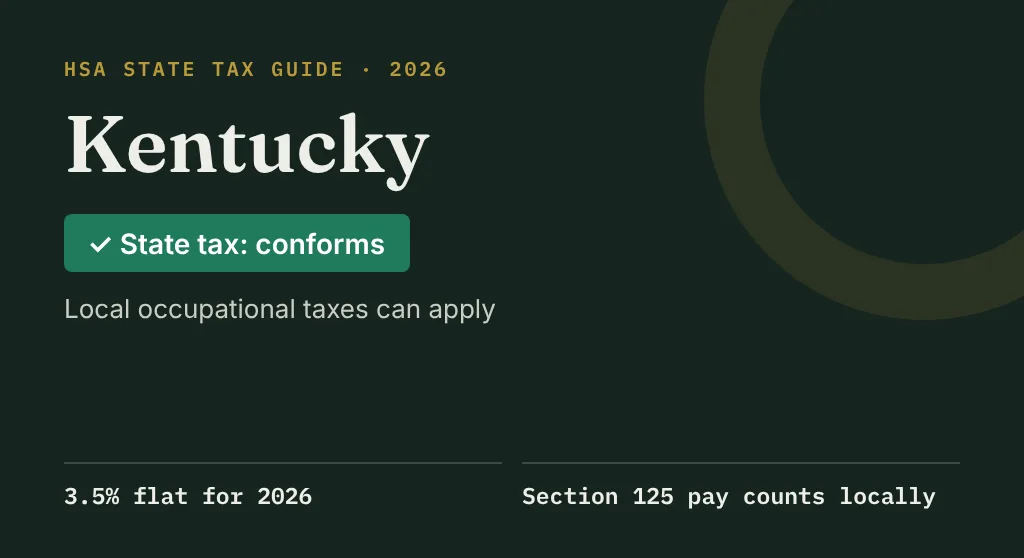
Kentucky's state income tax follows the federal HSA rules. Its local occupational taxes don't. If your city or county takes a slice of your paycheck, your payroll HSA contributions are probably part of what it taxes.
Key takeaways
- Kentucky's state income tax starts from federal AGI, so HSA contributions, growth and qualified withdrawals aren't state-taxed.
- Kentucky's flat rate drops to 3.5% for 2026, down from 4%.
- Local occupational license taxes are calculated on a broader wage base that, under state law, adds back Section 125 salary reductions. Payroll HSA contributions usually fall in that bucket.
State tax: fully conforming
Kentucky begins its individual return from federal adjusted gross income, and the HSA deduction is subtracted before AGI. So the contribution never reaches the state rate. Kentucky ties itself to the Internal Revenue Code as of a fixed date (recently moved to December 31, 2024), which covers the long-standing HSA rules.
Local occupational taxes: the catch
Many Kentucky cities and counties charge an occupational license tax on wages. The state law that governs these taxes, KRS 67.750, defines taxable compensation as wages reported for federal purposes and then adds back two things: retirement deferrals like 401(k) and 403(b) contributions, and amounts an employee contributes to "any welfare benefit, fringe benefit, or other benefit plan made by salary reduction," naming Section 125 of the Internal Revenue Code.
Payroll HSA contributions almost always run through a Section 125 cafeteria plan. So while they escape federal and state income tax, they generally count as wages for the local occupational tax. Contributions you make on your own, outside payroll, were never part of wages and don't come into it.
Local rates are usually a percent or two, so on a $4,400 contribution the cost is modest. Your pay stub will show the local tax, and your payroll office can confirm how your locality handles it. This is the same kind of state-versus-local split New York City has.
What it's worth at 3.5%
At Kentucky's 2026 rate, a $4,400 self-only contribution saves about $154 in state tax and an $8,750 family contribution about $306. Add federal income tax savings, plus Social Security and Medicare savings on payroll contributions. Run your own figures in the contribution calculator.
Quick answers
Does Kentucky tax HSA contributions?
Not at the state level. Kentucky starts from federal adjusted gross income, which already excludes HSA contributions. Local occupational license taxes are different and can apply to payroll HSA contributions.
Do Kentucky city and county occupational taxes apply to HSA payroll contributions?
Generally yes. Kentucky's statute for local occupational license taxes (KRS 67.750) defines taxable compensation to include employee contributions made by salary reduction under Section 125 of the Internal Revenue Code, which is how most payroll HSA contributions are made.
What is Kentucky's income tax rate in 2026?
3.5%, down from 4% in 2025, under House Bill 1 signed in February 2025.
Sources: KRS 67.750 (definition of compensation); Kentucky 2025 HB 1 fiscal note; Kentucky Department of Revenue; IRS Publication 969 for federal HSA treatment.
Your next step
Learn what applies to you, run your own numbers, then act on it.