Massachusetts HSA Tax Rules: Full Conformity at a Flat 5%
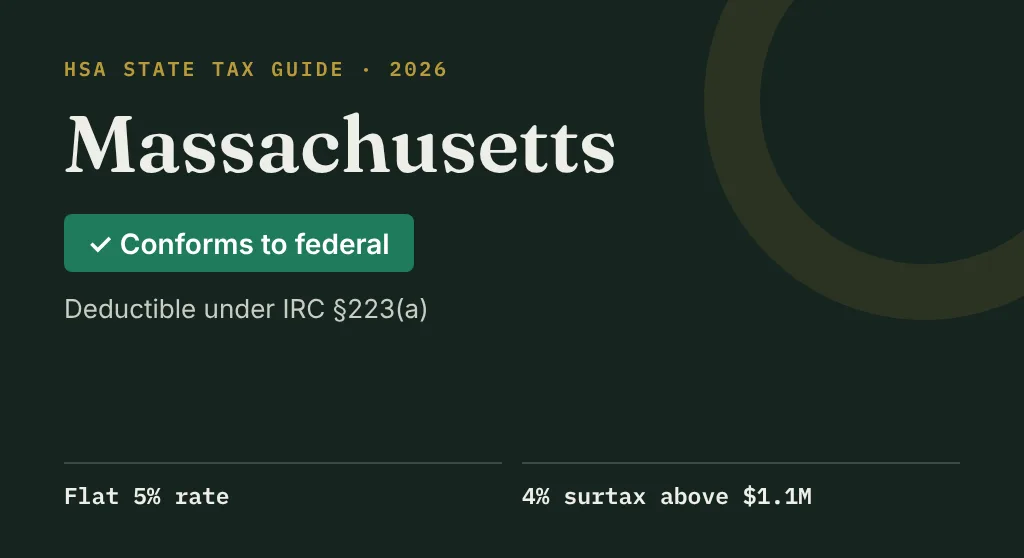
Massachusetts follows the federal HSA rules all the way through: contributions are deductible, growth isn't taxed and qualified withdrawals stay tax-free. The Department of Revenue spells this out directly, which isn't true in every state.
Key takeaways
- Massachusetts conforms to the federal HSA deduction (IRC §223(a)) and the exclusion for qualified distributions (§223(f)).
- At the 5% rate, a $4,400 self-only contribution saves about $220 in state tax; a full $8,750 family contribution saves about $438.
- The 4% surtax starts above $1,107,750 of taxable income for 2026. For most families it never comes into play.
What the state confirms
The Massachusetts Department of Revenue states that it conforms to the federal deduction for HSA contributions, that earnings "accrue on a tax-free basis," and that it follows the federal exclusion for distributions used on qualified medical expenses. It also notes that for 2020 and later, over-the-counter medicine and menstrual products count as qualified expenses with no prescription, matching the federal change made by the CARES Act.
So the rules on what you can buy are the federal ones. If an item is eligible under IRS rules, a withdrawal for it is tax-free in Massachusetts too.
What the deduction is worth
Massachusetts taxes most income at a flat 5%. That makes the state savings easy to estimate: multiply your contribution by 0.05.
- $4,400 self-only: about $220
- $8,750 family: about $438
- With the $1,000 catch-up at 55: add $50
That sits on top of your federal savings. If you contribute through payroll, you also skip Social Security and Medicare tax on that money, which an individual contribution doesn't. Check your exact limit in the contribution calculator.
The 4% surtax
Since 2023, Massachusetts adds a 4% surtax on taxable income above a threshold that adjusts each year: $1,083,150 for 2025 and $1,107,750 for 2026. The HSA deduction lowers taxable income like any other deduction, so for the few households sitting just above the line it's worth 9 cents on the dollar instead of 5. For everyone else it's a footnote.
Quick answers
Does Massachusetts tax HSA contributions?
No. Massachusetts conforms to the federal HSA deduction under IRC 223(a), so contributions within the federal limit are deductible on your Massachusetts return.
Are HSA earnings and withdrawals taxed in Massachusetts?
No. The Department of Revenue says HSA earnings accrue tax-free and distributions for qualified medical expenses are excluded from income, following IRC 223(f).
What is the Massachusetts income tax rate in 2026?
5% on most income, plus a 4% surtax on taxable income above $1,107,750 for 2026.
Sources: Massachusetts DOR, tax treatment of HSAs; Massachusetts DOR, tax rates; IRS Publication 969 for federal HSA treatment.
Your next step
Learn what applies to you, run your own numbers, then act on it.