Washington HSA Tax Rules: No Income Tax, and a Capital Gains Tax That Skips Your HSA
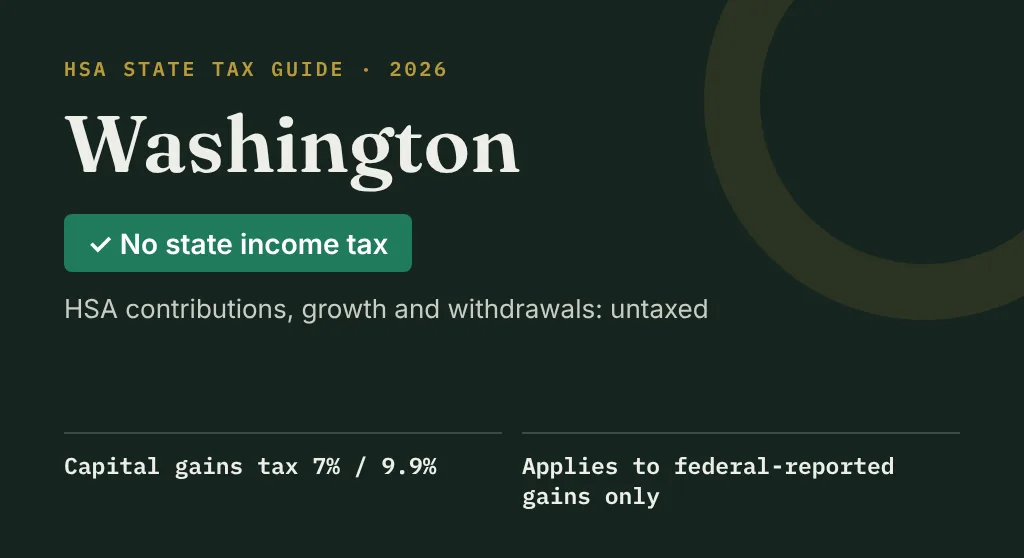
Washington doesn't tax wages, interest or dividends, so your HSA gets the full federal treatment with nothing added at the state level. The one question worth answering is the state's capital gains tax, and it doesn't reach money invested inside an HSA.
Key takeaways
- Washington has no personal income tax. HSA contributions, growth and qualified withdrawals face no state tax.
- The state's capital gains tax (7%, and 9.9% on gains above $1 million starting with 2025) applies to long-term gains reported on your federal return. Gains inside an HSA aren't reported there.
- You file nothing with Washington for your HSA. The federal Form 8889 is the only form.
No income tax, no HSA question
Because Washington doesn't tax personal income, there's no deduction to claim and no add-back to worry about. Contribute through payroll or on your own, invest the balance, and reimburse yourself whenever you like. The 2026 limits are federal and identical in every state: $4,400 self-only, $8,750 family, plus $1,000 if you're 55 or older.
That makes Washington one of the best places to run the pay now, reimburse later strategy. Every dollar of growth stays out of reach of state tax for as long as it compounds.
Where the capital gains tax fits
Washington does tax one kind of income: long-term capital gains above a standard deduction ($278,000 for 2025, adjusted each year). The rate is 7%, and beginning with tax year 2025 gains above $1 million are taxed at 9.9%.
The tax is calculated from the long-term gains on your federal return. When your HSA's funds sell and rebuy inside the account, none of that is reported on your 1040, because an HSA is a tax-exempt account under IRC §223(e). So those gains never enter the Washington calculation in the first place.
One honest caveat: the Department of Revenue's guidance exempts retirement accounts (IRAs, Roth IRAs, 401(k)s and similar) by name, and it doesn't mention HSAs either way. For nearly everyone this changes nothing, since the tax only reaches people with very large gains to begin with. If you're in that group, confirm with a tax professional.
If you move out of Washington
Your HSA follows you, but state treatment doesn't. Move to California or New Jersey and the state starts taxing contributions and growth. Move to Texas, Florida or Tennessee and nothing changes. The all-states table shows every state at a glance.
Quick answers
Does Washington tax HSA contributions?
No. Washington has no personal income tax, so there is no state tax on HSA contributions, investment growth or withdrawals.
Does Washington's capital gains tax apply to investments inside an HSA?
In practice, no. Washington's capital gains tax starts from the long-term gains on your federal return, and trades inside an HSA never show up there. The Department of Revenue exempts retirement accounts by name but does not list HSAs, so ask a tax professional if you have an unusual situation.
Do I need to file anything with Washington for my HSA?
No. There is no Washington income tax return. Your only HSA paperwork is federal: Form 8889 with your Form 1040.
Sources: Washington Department of Revenue, capital gains tax; DOR special notice on tiered rates; DOR capital gains FAQ; IRS Publication 969 for federal HSA treatment.
Your next step
Learn what applies to you, run your own numbers, then act on it.